Spyderco Para 3 Lightweight vs Benchmade Mini Bugout: Which Should You Buy?
Which one belongs in your pocket? The Benchmade Mini Bugout or the Spyderco Para 3 LW

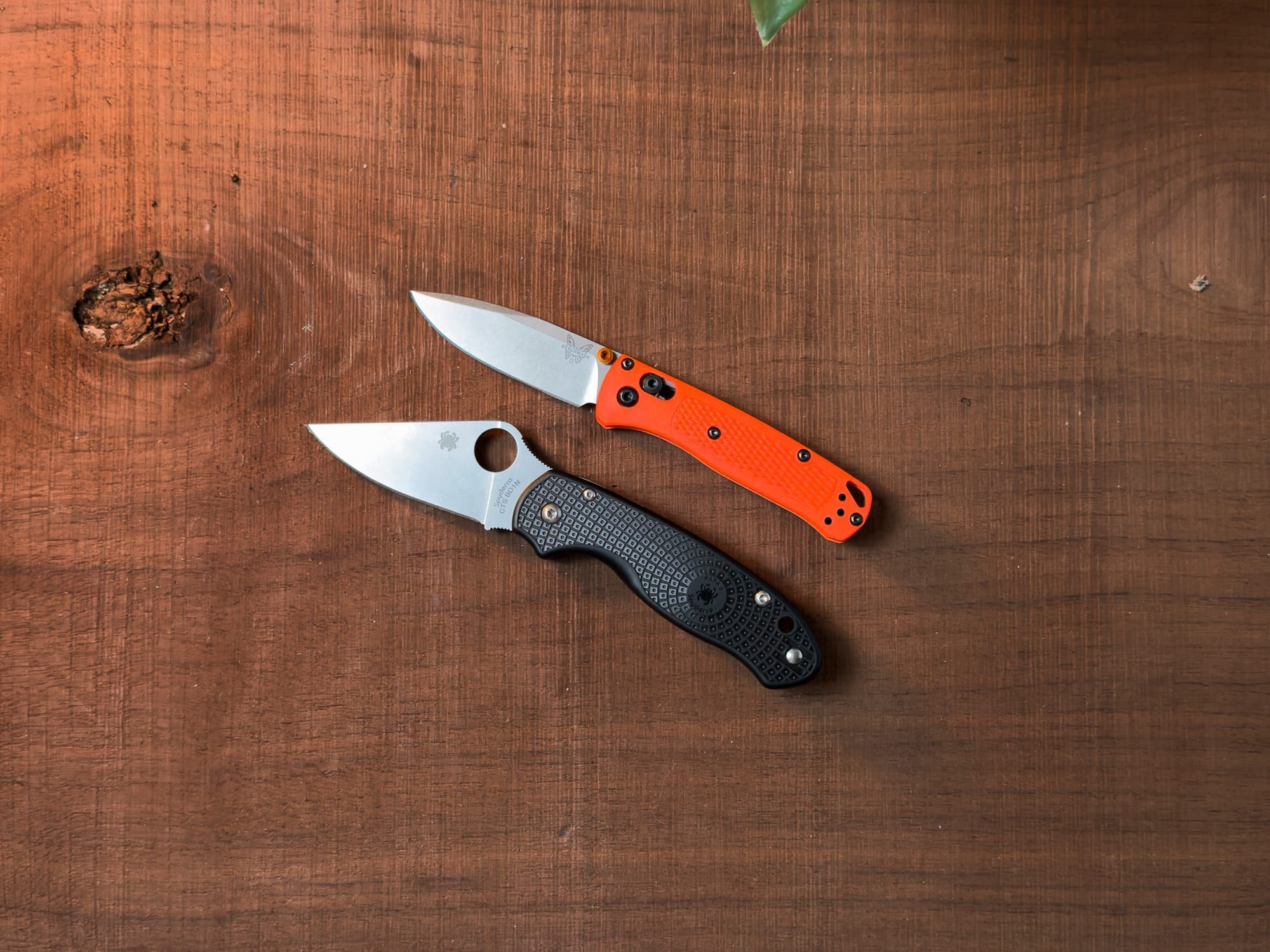
If you have spent any time in the EDC knife world, you have probably had this debate with yourself at some point. Two of the most popular lightweight folders on the market, the Benchmade Mini Bugout in S30V and the Spyderco Para 3 Lightweight in BD1N(also a "salt" version in Magnacut), both occupy a similar price range and promise to be the knife you forget is on you until you actually need it. But they take very different approaches to getting there, and choosing the wrong one for your lifestyle can leave you frustrated.
I will be upfront: I am a Spyderco guy at heart. Always have been. But that does not mean I cannot give credit where it is due, and the Mini Bugout genuinely earns a lot of that credit. Let me walk you through how these two stack up in the real world after extended use, covering steel, ergonomics, grip texture, hardware, and who each knife is actually built for.
The Steel Story: S30V vs. BD1N
Steel selection is often the first thing knife enthusiasts look at, and these two blades represent very different philosophies.
S30V is an American-made premium stainless steel developed by Crucible Industries and popularized in part by Chris Reeve. It offers an excellent balance of edge retention, toughness, and corrosion resistance. On the Rockwell scale, Benchmade typically runs S30V in the 58-60 HRC range on the Mini Bugout, which gives you a blade that holds an edge through extended cutting tasks without becoming brittle. When you do need to sharpen it, S30V responds well to ceramic rods and diamond stones, though it does require more effort than softer steels. For everyday carry tasks like breaking down boxes, opening packages, food prep, and general utility work, S30V is hard to beat at this price point. It is a proven performer that has earned its reputation over many years.
BD1N is a Japanese stainless steel manufactured by Hitachi, and it is a steel that often gets underestimated. The "N" designation means it has been treated with a nitrogen infusion process, which enhances its corrosion resistance significantly over standard BD1. We are talking about a steel that laughs at moisture, salt air, and the kind of wet conditions that would have other steels showing surface rust within days. The tradeoff is that BD1N does not hold an edge quite as long as S30V. It runs at a slightly lower hardness, which also means it is easier to sharpen when the time comes. A few strokes on a strop or a quick pass on a fine stone and you are back in business.
So what does this mean in practice? If you are carrying in a humid coastal environment, doing a lot of outdoor work in wet conditions, or just someone who tends to neglect their knife maintenance longer than they should, BD1N's corrosion resistance is genuinely useful. If you want a steel that goes longer between sharpenings and you are not punishing it with moisture, S30V is the stronger choice for edge retention.
Check out my YouTube channel where I have done detailed edge retention testing on both of these steels so you can see exactly how they perform in real cutting tasks.
Ergonomics and Grip: Where the Real Differences Show Up
This is where my personal preference for Spyderco really comes through, and I think it is the most important category for most users.
Benchmade Mini Bugout: Minimalism
The Mini Bugout is a genuine feat of engineering when it comes to weight. Benchmade achieved an almost unbelievably low carry weight by going with Grivory scales and a skeletonized aluminum frame. The result is a knife that genuinely disappears in your pocket. If ultralight carry is the single most important thing to you, the Mini Bugout makes a compelling argument.
But here is the thing: that minimalism comes at a cost during actual use. The Grivory scales are smooth. Very smooth. They look clean and modern, but in real-world grip situations, especially if your hands are at all damp or dirty, you are going to notice the absence of texture. There is no aggressive grip pattern, no stippling, no jimping on the scales to give your fingers purchase. For light cutting tasks this is not a big deal. For anything that requires a firmer hold or more controlled cutting pressure, the lack of texture becomes genuinely noticeable.
The other issue that only shows up after extended carry is the pocket clip. The Mini Bugout's clip has some sharper edges that begin to dig into your hand during use over time. It is not something you notice immediately, but after carrying the knife for a few months and using it regularly, that clip edge starts to make itself known during heavier cutting sessions. It is a real-world complaint that does not show up in initial impressions but matters for long-term ownership.
There is also no jimping on the thumb ramp of the Mini Bugout. For a knife at this price point, that is a notable omission. Jimping gives your thumb a tactile reference point and keeps your grip from shifting forward during use. Without it, the already smooth scales make it harder to maintain a consistent, confident grip.
Spyderco Para 3 Lightweight: Built to Be Held
The Para 3 Lightweight approaches the lightweight mission differently. Yes, it uses FRN (Fiberglass Reinforced Nylon) scales to shed weight, but Spyderco did not strip the ergonomics along with the grams. The FRN on the Para 3 Lightweight has that characteristic bi-directional texture that Spyderco has been refining for decades. It grips like it means it. Even with wet hands, the Para 3 Lightweight stays put in your grip.
Beyond the texture, the handle geometry gives you genuine palm contact. The fuller handle profile wraps your hand properly and provides the kind of confident feel that lets you apply real cutting force without worrying about your grip slipping or shifting. This is the knife you reach for when the cutting task is not trivial.
The jimping on the thumb ramp is excellent. It is aggressive enough to actually do its job without being uncomfortable during normal carry or light use. Your thumb locks in, and the knife becomes an extension of your hand in a way that the Mini Bugout simply cannot match.
The Para 3 Lightweight is noticeably heavier than the Mini Bugout, but it still qualifies as a genuinely lightweight carry. The weight difference between the two is real but not dramatic, and in exchange for those extra grams you get substantially better in-hand performance.
I cover this grip comparison in detail on my YouTube channel if you want to see it side by side.
The Mechanisms: AXIS vs. Compression Lock
The Benchmade Mini Bugout runs the iconic AXIS lock, which Benchmade has been perfecting for decades. It is ambidextrous, smooth, and allows for one-handed opening and closing without having to roll your fingers toward the blade edge. It is genuinely one of the best lock mechanisms in production knives.
The Para 3 Lightweight uses Spyderco's Compression Lock, which is also ambidextrous and arguably even more secure under heavy lateral loads. Both locks inspire confidence, and neither is going to fail you in normal use. This category is essentially a draw between two excellent designs.
Pocket Presence and Carry
The Mini Bugout wins this category outright. The skeletonized construction and Grivory scales make it one of the lightest production knives at this size, and the clip positions it well in the pocket without printing noticeably. If your primary concern is having a knife that you genuinely forget about until you need it, the Mini Bugout is hard to beat.
The Para 3 Lightweight carries well too and is far from a heavy knife, but it does have a more substantial presence compared to the Mini Bugout. The clip on the Para 3 Lightweight is comfortable during use and does not develop the sharp-edge problem you eventually encounter with the Mini Bugout clip.
Price and Value
Both knives sit in the mid-range production knife market. Prices fluctuate, but you are generally looking at comparable street prices for both. I have affiliate links below where you can check current pricing and grab either knife if one of these ends up being the right fit for you.
The value proposition differs based on what you prioritize. The Mini Bugout gives you better steel and ultralight carry. The Para 3 Lightweight gives you better ergonomics and superior corrosion resistance. Neither one is a bad buy.
Who Should Buy the Benchmade Mini Bugout in S30V?
The Mini Bugout is built for the person who puts carry weight above all else. If you are the type who notices every gram on your person and wants the knife equivalent of not being there until you need it, the Mini Bugout delivers. It is also the right pick if you want a step up in steel performance and are willing to accept the smoother, more minimal grip in exchange. Collectors and those who appreciate the engineering achievement of a knife this light at this price will find a lot to love.
Just know going in that it is not the knife for demanding cutting tasks or situations where your grip security matters most.
Who Should Buy the Spyderco Para 3 Lightweight in BD1N?
The Para 3 Lightweight is for the practical user who wants a tool first and a collector piece second. If you work in wet or humid environments, spend time outdoors, or just want a knife with corrosion resistance that requires minimal babying, BD1N is genuinely the right steel choice. The grip is excellent, the jimping works, and the ergonomics hold up under real use conditions. You will sharpen it more often than the Mini Bugout owner sharpens theirs, but you will also carry a knife that feels like it was designed to actually be used.
For the Spyderco faithful, this one feels like home.
Final Verdict
Both of these knives earn their place in the conversation. The Benchmade Mini Bugout in S30V is an impressive piece of engineering that prioritizes low weight and better edge retention steel. The Spyderco Para 3 Lightweight in BD1N prioritizes usability, grip security, and corrosion resistance.
If I have to choose one for daily carry and actual use, the Para 3 Lightweight wins every time. The grip, the texture, the jimping, and the ergonomics make it the more satisfying knife to actually put to work. But if you are building a lightweight carry collection or want a knife that practically vanishes in your pocket with solid steel behind it, the Mini Bugout is worth every penny.
Use my affiliate links below to check current prices on both, and head over to my YouTube channel for the full hands-on comparison video where I put both of these knives through their paces.
[Check Price Here: Benchmade Mini Bugout] [Spyderco Para 3 Lightweight] [EDCGarageco. YouTube]
DISCLAIMER:
This post contains affiliate links. If you purchase through my links I may earn a small commission at no extra cost to you. I only recommend gear I personally own or have tested.